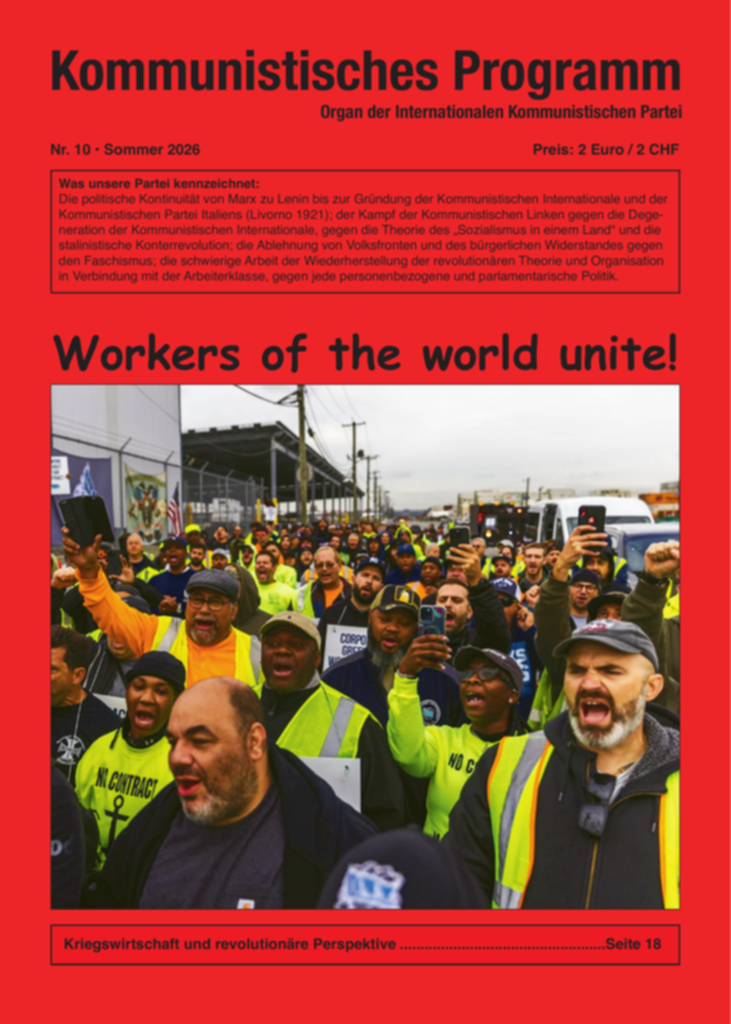
On the day of May 1, the immense gathering of proletarians from all over the world must recover the use of its class power to fight the chains of all bourgeois, imperialist and war-mongering States and take back the control of its own destiny, shaking off all the ideological, economic, social and political oppression of the bourgeoisie. On the day of 1 May, the proletariat, which speaks all the languages of the world, must contrast the nationalism, servitude and deception implemented by the various bourgeoisies in their imperialist wars, with the flag of its own united, international battle.
The events that continue to follow on one another in the Middle East certainly don’t find us unprepared. We have always pointed to that area (even before 1945, as can be seen in the pages of our Prometeo, published in the years between the two world wars) as one of those where the contradictions of capitalism are to be felt the most, exploding more and more frequently and violently – as happened in the Balkans around the time of the First World War. Another area of increasing tension has its centre in Ukraine: so we might say that a single faultline of social and political instability links Europe to the Middle East.