
1. Towards complete collapse
What can the world’s leading power do when it finds itself dragged down into the worst economic and political crisis in the history of capitalism? We are, of course, referring to the United States.
To answer the question we need look no further than Rosa Luxemburg’s astute writings on the bourgeoisie’s use of tariffs as part of its global politics. She said there are two aspects to the accumulation of capital: on the one hand, production and circulation – a purely economic relationship, where the crux of the issue lies in the relationship between capital and labour (the critique of bourgeois political economy scientifically thrashed out by our comrade is clear on this matter here); on the other, the ‘world stage’. By this she means the immense, tragic theatre made up of war, bullying, violence, shouting and lies. Politics, in other words. And “Force, fraud, oppression, looting are openly displayed without any attempt at concealment, and it requires an effort to discover within this tangle of political violence and contests of power the stern laws of the economic process”.[1]
Indeed, it would seem there is only emptiness behind the ostensibly schizophrenic policies of Trump – no rational foundation, no underlying logic. Behavioural incoherence would appear to be the determining factor. The production and circulation of capital is a first prerequisite of accumulation: but, under the latest ‘hothead’ required to guarantee this operation, it would seem to be totally absent.
Indeed, as Luxemburg continues: ‘Bourgeois liberal theory takes into account only one of the two aspects: the realm of ‘peaceful competition’, the marvels of technology and pure commodity exchange. It separates strictly the other aspect: the realm of capital’s blustering violence, regarded as more or less incidental to ‘foreign policy’ and quite independent of the economic sphere of capital. In actual fact, political power is nothing but a vehicle for the economic process. These two aspects of the accumulation of capital are organically linked by the conditions for the reproduction of capital, and only by taking them together can the historical cycle of capitalism be accomplished. Not only does capital ‘sweat blood and mud from every pore’ at its birth, but also at every inch of the way, during its gradual march across the world. In this way, under ever more violent contortions and convulsions, it prepares its own downfall’ [2]
Today, the propaganda of the bourgeoisie – be it on the left or the right – enacts the same falsification as yesterday to protect itself. In other words, it separates the two aspects to muddy the waters and make it difficult to see that the underlying force behind capitalist development is the violence exercised by the dominant class to maintain, empower and optimize the relations between capital and labour to its own advantage. Indeed, it does more than simply separate: today it spectacularizes the political aspect to create even wider confusion.
Going back to our question then: if the accumulation of global capitalism is in crisis due to growing difficulties in achieving valorization, and if this crisis also hits the world’s greatest power, how will this power react? It will do everything it can to remedy the weak element in crisis inside the accumulation. And it will do this precisely on the world stage. Trump’s fulfilment of his historical role is timely and appropriate: no longer is he the President of the single, unrivalled world superpower, but the President of a leading world power that is unsteady on its feet and at odds with political-economic blocs (China and Russia) ready to devour it.
For this reason, Trump’s tariffs policies satisfy a very precise need. Luxemburg continues: ‘The inherent contradiction of an international policy of protective tariffs, exactly like the dual character of the international loan system, is just a reflection of the historical antagonism which has developed between the dual and conflicting interests of accumulation: expansion, the realisation and capitalisation of surplus value on the one hand, and, on the other, an outlook which conceives of everything purely in terms of commodity exchange.’ [3]
And so, by dominating the skies and seas, the USA blackmails satellite countries, vassal states and partners, threatening them with tariffs – or indeed, actually imposing them – so as to improve its own domestic and foreign market conditions and get some kind of grip precisely on that capital-labour relation currently in crisis. And the self-regulating free market? A fairy tale. The Americans never believed in it either.
‘This fact is evidenced particularly in that the modern system of high protective tariffs, required by colonial expansion and the increasing inner tension of the capitalist medium, was also instituted with a view to increasing armaments. [...] European Free Trade, with its attendant continental system of infantry, had been superseded by protective tariffs as the foundation and completion of the imperialist military system with a strong bias towards naval power.’ [4]
Clearly, about 100 years on from the words of Luxemburg, the American fleet has already paved the way worldwide for protectionism in its own country. Unlike in the past, however, its centre of gravity is increasingly shifting towards the conclusion of an entire historical process, because the fleet (sweating mud and blood in the shape of capital) has gradually exported the end of capitalism across the world and, under ever more violent contortions and convulsions, it prepares its own downfall.’ [5]
But the collapse of the system will never be a definitive solution. Theoretically, capital, as such, will be able to reproduce itself ad infinitum, until such time as its rules of operation are destroyed: when, that is, the capital-labour nexus will be extirped only by the dictatorship of our class.
Ad infinitum, in theory. But in practice, no. Because one thing is certain: capital will result in the extinction or complete destruction of our species. So a hypothetical end point does exist. Too many scientistic and neo-positivist positions within Marxism are in the process of restoring bourgeois thought among our class, complete with their ideological distortions and fanatical admiration of progressive evolution.
Contrary to widespread opinion, developing the forces of production is more than a question of technology. Everything – including the political programme – revolves around the proletariat, which is the primary force of production for Marx. The human and social foundations of our class are being torn to shreds by technological progress: it is being expropriated of everything that had survived up until the second industrial revolution. Placing at risk its own survival, capital is warring against its opposite pole – its negation, its undertaker – alienating it from its selfsame existence to render it harmless, non-existent even. When scientistic theories suggest that technological progress will lead us to communism, there isn’t a great deal to celebrate! Rearmament policies – of which tariffs are a sign, and Trump (their tool of the moment) – are policies that accelerate technological warfare, weighing heavily upon the collective physical and psychological well-being of our class in its civilian context. The collapse may take on many different forms – and that doesn’t exclude the possibility that capital crushes its opposite definitively, thereby destroying itself too, obviously.
The military sphere has always played an important role in accelerating the use of technology in civilian life. Such developments are worrying to say the least. It is of little benefit for us to know that in the human-less world of the future – a place where ‘leading global powers’ and crises are completely absent – self-replicating robots will operate within a system where social classes and the market are unknown. For Marxists, a world of this kind would be a disaster, a total failure, even if technological progress will have removed all the other bugbears in the meantime too. So, the answer to our question is: to escape the crisis, the leading global power will fight against the worldwide proletariat! Combating pre-emptively its organization and political unity, it will exploit it to the full, bending it to its will as never before with all the means technology currently puts at its disposal!
But let’s get back to basics.
2. Economy and Politics. Structure and Superstructure.
Economic analysts and geopolitical experts already had a hard time understanding the evolution of capitalism. Faced with Trump’s supposedly unpredictable decision-making, they now scratch their heads in total dismay. Impotent and forlorn, every day they anxiously await the latest pronouncement to determine the world’s fate to issue from the lips of the energumen at the head of the dominant imperialist power. So was the theory of historical materialism a failure? This theory posited that the economy was the structure of society underlying historical development, and ideological superstructures like politics took their origins from that. But now it seems as if the destiny of the world depends on the mercurial temperament of a whacky man in the White House – the political head honcho of the dominant imperialism! As was suggested above, however, recent protectionist policies are actually a response to economic or structural necessities; and the roots of these policies go back to a period of time well before Trump the puppet took the stage. Indeed, they are a continuation of tendencies that had already emerged during Obama’s administration (see the 2009 ‘Buy American’ clause as a response to the economic crisis of 2007/2008). [6]
Recent developments have proved impenetrable for the great intellectual minds of the bourgeois pseudoscience but serve to demonstrate and confirm the validity of the revolutionary Marxist standpoint. In order to understand how post-Second World War monopolistic ‘liberalism’ turned into the neo-protectionism of the 1970s, then morphed back into the ‘liberalism’ of globalization halfway through the eighties, before ending up as the protectionism of Trump, is in fact possible only through the use of Marxist scientific analysis.
‘According to the Materialist Conception of History, the factor which is in the last instance decisive in history is the production and reproduction of actual life. More than this neither Marx nor myself ever claimed. If now someone has distorted the meaning in such a way that the economic factor is the only decisive one, this man has changed the above proposition into an abstract, absurd phrase which says nothing. The economic situation is the base, but the different parts of the structure-the political forms of the class struggle and its results, the constitutions established by the victorious class after the battle is won, forms of law and even the reflections of all these real struggles in the brains of the participants, political theories, juridical, philosophical, religious opinions, and their further development into dogmatic systems-all this exercises also its influence on the development of the historical struggles and in cases determines their form’[7].
‘Men make their history themselves, but not as yet with a collective will or according to a collective plan or even in a definitely defined, given society. Their efforts clash, and for that very reason all such societies are governed by necessity, which is supplemented by and appears under the forms of accident. The necessity which here asserts itself amidst all accidents is again ultimately economic necessity [...] So with all the other accidents, and apparent accidents, of history. The further the particular sphere which we are investigating is removed from the economic sphere and approaches that of pure abstract ideology, the more shall we find it exhibiting accidents in its development, the more will its curve run in a zig-zag. So also you will find that the axis of this curve will approach more and more nearly parallel to the axis of the curve of economic development the longer the period considered and the wider the field dealt with.’ [8]
3. The average rate of profit
We will now demonstrate how the apparently contradictory and random development of capital can be explained and contextualized in terms of objective deterministic laws on the basis of economic parameters and, especially, the average rate of profit.
The method involves moving from the complexities of the real and concrete to the ultimate abstractions and determining elements, and back to the complexities of the real and concrete – only this time not as the chaotic representation of an accidental whole but, rather, as a totality steeped in many determinations and cause and effect relations.”[9]
We live in a historical era called capitalism because it is determined by capitalist production. The aim of capital is to grow, increase in value, otherwise it wouldn’t be capital. This growth occurs through the extortion of unpaid labour, surplus labour or surplus value: the bourgeois economy calls this ‘profit’. No limits are imposed upon this growth, which must occur continually if failure is to be avoided. Forms of capital are always competing among themselves in the ineluctable drive for valorization. The imperatives of competition are the reason for and also the stimulus behind the introduction of mechanized systems in every act of production, as well as the continual renewal of the selfsame technical production system with increasingly efficient machines. Exceptions made for the occasional momentary deviation, the general tendency of capitalism – as Marx himself demonstrated – is towards increased productivity. As a consequence, living labour (wage earners) is increasingly forced to make way for dead labour (machines).
In this way, however, capital eliminates the source of profit. This tendency is measured precisely by the tendential fall in the average rate of profit. The amount of capital invested must be ever greater to compensate for its decreasing capacity for valorization, but the greater the capital invested, the more difficult it becomes to grow still further. Profit is made if the surplus value extorted from the labourer during production is realized on the market. Yet no matter how hard capital works, the market can never keep pace with the massive expansion in production. The need to valorize and the difficulties involved in the process of valorization are the major factor behind determining the history of capitalism, and that’s why the tendential fall in the average rate of profit is so important. Here we will limit ourselves to using this powerful instrument to analyse the tendencies towards protectionism and, therefore, the war economy. At the same time, the growing difficulty of valorization is, in the final analysis, the reason underlying the movement towards the revolutionary overthrowing of the capitalist system, with all that implies in terms of the class struggle.
4. The false antithesis between neo-liberalism and protectionism
For centuries capitalism has veered between protectionism and free trade. Far from being contradictory, these policies are dialectically functional to the economic necessities of different evolutionary phases in the mode of production in different geo-historical areas, while also reflecting power relations in the world market. The clear cut, metaphysical ‘antithesis’ between liberalism and statism is false. “The risk for those who attempt to analyse the differences between neoliberalism and statism is a state of confusion. The world’s most powerful microscopes are unable to detect systematic divergencies: even the most typical neoliberal state carries the strain of statism while the dogma of the ‘statist’ state, so to speak, posits an ‘unfettered’ development of capital [...] The neoliberal State tends to prioritize the integrity of the financial system and the solvency of financial institutions over environmental quality and the well-being of the population. Mountains of data would seem to confirm that the ‘economic agent”, the State, has behaved in like fashion.’[10] The tendency of the modern world to replace and integrate classic liberalism with totalitarian cum-fascist political superstructures has been evident ever since the economic phase of monopolistic capitalism began more than a century ago. Monopolistic capitalism (imperialism) does, in fact, require a state apparatus in harmony with its needs, while the ‘minimum’ state with maximum individual liberties (cornerstones of liberal thought) has had to yield ground to policies that are able to respond to the growing need to regulate economic and financial phenomena. ‘Protectionism has been intrinsic to capitalism from the very beginning. Protectionism and liberalism can always co-exist, and even the current phase shows this to be true: liberal attitudes generally express a position of strength on world markets on the part of powers that are able to impose their goods and investments on their partners by means of economic and military blackmail.’ [11]
Let’s take a closer look at the economic cycles from the end of the Second World War on. The USA was in a dominant position on the world markets up until the 1960s, supporting the opening of markets to goods and capital (creation of GATT and IMF). From the end of the sixties, and especially from midway through the next decade (1975-75 crisis, and new oil crisis in 1979), protectionism returned in vogue as a reaction against the fall in American industrial production and, consequently the average rate of profit. This was particularly the case in the strategic automobile and steel sectors. This marked the beginning of the so called neo-protectionist phase, a knee-jerk reaction to the panic surrounding stagflation (high unemployment and inflation). Confusing monetary policies with alternating high and low tax rates (‘Stop-Go’) were introduced, but inflation wasn’t brought under control and industrial production remained in a rut. Capital fled to finance ... and the cure turned out to be worse than the disease, with inflation running at 13-14% at the beginning of the eighties! A sea change was necessary: cue Volker’s monetarist shock policy (with a massive hike in interest rates) and the pro-market reforms of Ronald Regan. This spelt the end of stagflation but led to a steep recession: industrial production collapsed and unemployment was running at 10.8% in December 1982, the highest level since the Great Depression. The automobile and building sectors were on their knees, and the Midwest ‘Rust Belt’ never fully recovered from a crisis without precedents. It was the worst recession in the States since the end of the Second World War.
Solutions of an opposing nature were formulated after the failure of protectionist policies. The protectionism of the seventies was thought to have fathered the economic collapse that the neo-liberalism of the next decade sought to address in its guise as child and fixer: instead of shielding itself against the global economy, the US would remodel its own economy to dominate that of the entire world. This new approach paved the way for globalization and the integration of world markets: the recession of the early eighties was the high price to be paid for such a transition. Naturally, the abandonment of blanket protectionism didn’t imply a return to an illusory form of laissez-faire or a dewy-eyed trust in the ‘invisible hand’ of the market. What it did involve was a pragmatic kind of free exchange (albeit with a measure of protectionism in strategic sectors thrown in: no surprises there), where liberalist and protectionist policies slept side by side: the label "neoliberalism" was artificially attached to all of this. The anguished search for the causes of the crisis and its possible solutions was a more or less empirical groping in the dark process that never got to grips with the underlying reasons for its occurrence: the fall in the average rate of profit. The economic liberalism vs protectionism merry go round is simply an expression or reflection of a vicious circle that cannot be resolved except through the antithesis: either war or revolution.
5. The end of globalization
The tide of liberalization that engulfed the world from approximately the mid-eighties on with its free movement of capital, outsourcing and the explosion of Chinese exports also came to a close with its own crisis in 2008. [12] And when the crisis came, liberalization only succeeded in accelerating it and determining its global contagion. Protectionism had already raised its head as the nineties drew to a close, but only came fully into the picture in 2008 as banks went bankrupt and a deep, long-lasting widespread crisis took hold. Globalization as a counteracting tendency to the fall in the average rate of profit temporarily gave a temporary vent to overproduction but, in doing so, it generated a whole series of contradictions that (as Marxism predicted) dictated the conditions for a cycle of deeper, more wide-ranging and back-to-back crises from which the world has yet to emerge.
On a superficial level, the repeated cycle of long lasting crises was characterised by reduced global trade, negative trade balances and an enormous – and unsustainable – growth in public debt. In addition, the shackles were removed from creative finance, and the economy was financialised; the clash of imperialisms became more pronounced and capital and strategic sectors were repatriated. Global production chains encountered difficulties, today not only in terms of raw materials but especially semi-finished goods. Yet all these factors are, once again, the expression and reflection of the collapse in industrial production and, therefore, the tendential collapse of the average rate of profit. We had already understood this trend as early as 2010. [13]
As a mostly political-economic outlook, protectionism belongs to early industrial capitalism. During the final throes of today’s mode of production, a return to generalised protectionism hardly seems practicable unless (as Rosa Luxemburg, quoted above, observed) it immediately precedes open political-military conflict. And look around: is not the current imposition of tariffs accompanied by the militarisation of the economy? Among fashionable terms today we have ‘dual use’ – for example, technological development for military and civilian purposes (IA, satellite systems, infrastructures) – and ‘decoupling’, where the production of American companies in sectors held to be strategic in the event of open conflict (for example, steel, aluminium, shipbuilding and microchips) are relocated back to the USA. Yet contemporary protectionism is even more contradictory than that of the past because of the strong correlation, integration and mutual dependency that exists among differing economies and production systems (the USA and China come to mind at once ...). It is, therefore, less a solution to the crisis today than it was in the past. When a crisis breaks out and production is halted, the effects are felt immediately. Trade wars loom larger and real wars take their marks as countries get onto a war economy footing and social tensions mount. It comes as no surprise to learn that the US Department of Defense has recently changed its name to the US Department of War!
6. A recap. Tariffs and blackmail as a prelude to the ‘war or revolution’ antithesis
The more the capitalist mode of production tends to reveal its transitory nature, the more intellectuals and academics in its service have to distance themselves from science as a ‘search for the truth’ in order to carry out bourgeois class science that is forced to spread trust in future profits and create the illusion of a system of eternal production whose prospects for growth are unlimited. Only lunatics and economists can believe in eternal, unlimited growth in a world that is limited. Bourgeois science has therefore become vulgarized. For over a century it has repudiated Smith and Ricardo’s classic theory of value derived from labour, replacing it with superficial and subjective theories based on the interests of consumers and the workings of the market (Pareto, marginal utility). What is more, since the great depression of 1929 and the advent of Keynesianism, it has even replaced studies of the rate of profit with that of GDP. In short: GDP answers the question: ‘How much is the economy producing in absolute terms?’ while the rate of profit responds to more specific and important questions like: ‘On average, how profitable is the capital used?’; ‘How much is the workforce exploited?’; ‘How close is the crisis?’ GDP includes sectors like services and finance which, to a certain degree, operate freely from industrial production, temporarily giving the false impression that profits can grow independently of real production: an economy can clock positive GDP figures while having a falling rate of profit. GDP includes components that have no direct relationship to the profitability of capital – like public expenditure, for example. The longest and most thoroughly pored-over series of data is provided by the United States, and this clearly points towards two opposing trends: GDP has a strong tendency to grow over time, while the average rate of profit shows a clear tendency to decline.
The average rate of profit is studied by very few bourgeois economists nowadays and goes under a different name: Return on Capital (ROC). These economists work for international financial and governance institutions like the IMF and the World Bank which need to be able to understand dynamics over the long term: for example, knowing how productivity and investments are likely to perform in a given country, forecasting financial crises … In short, they too need to understand the risks involved when crises and stagnation take place – but without making too much noise. However, the bourgeois economists are prone to error: when calculating the average rate of profit, they only take into account the capital used by companies during the production cycle under consideration. In other words, they fail to consider all constant capital and, therefore, the degree of utilization of production capacity, as well as debt. Hence the average profit rates calculated using the method of bourgeois economists are superior to the real rates, yet they can’t escape the law of the tendential fall. The bourgeois economists know that companies cease to invest in the real economy if the return on capital (read: rate of profit) collapses, and the capital ends up in speculative finance where bubbles are created that, sooner or later, will burst and burn enormous masses of capital. The result? A more fragile, unstable and unequal economy. What happens in practice is that the more intelligent bourgeois economists rediscover Marx through their own models – especially in period of crisis – but always looking for solutions within the capitalist system.
The following graph[14] shows the historical trend of the average rate of profit in the USA from the end of the Second World War until 2021, summarizing what has been said here in graphic and quantitative terms.
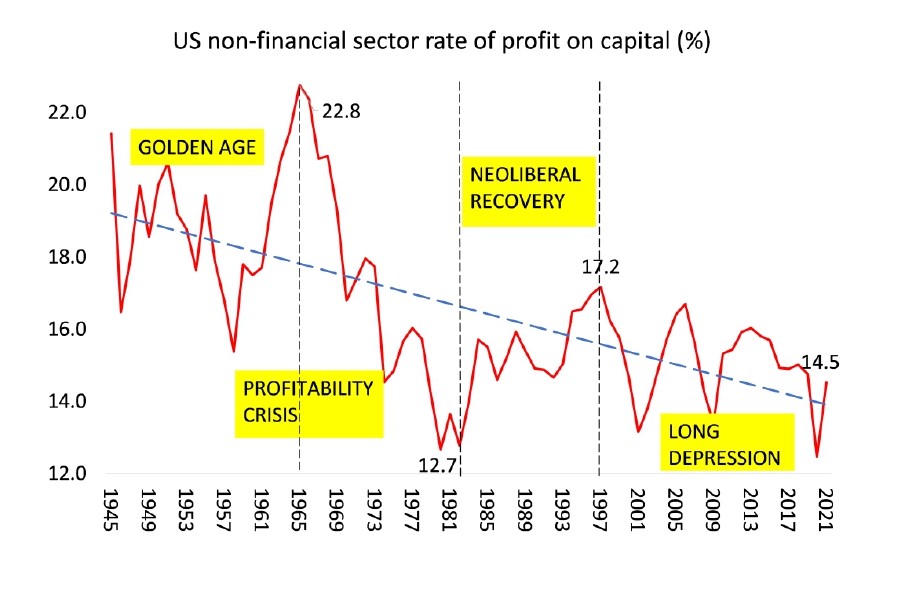
As for recent years, reliable sources (Kliman, Roberts, Piketty) that have calculated the rate considering total constant capital are in agreement: the real rate in the USA has been under 5% since 2010. The same sources have confirmed that the 2023-24 figure for the USA rate of profit calculated using Marx’s method has fallen to under 4%. Sure enough: Trump’s blackmail and tariffs hardly come as a surprise! “War is the continuation of politics”… and politics is the continuation of the economy!
The latest capitalist wheeze for shaking off the crisis in industrial production is called ‘Artificial Intelligence’. AI is supposed to bring about a new increase in production … lowering still further the average rate of profit. Some soothsayers go so far as to suggest that AI will eliminate labour completely from production, without realizing that this would nullify surplus labour, surplus value and, hence, profit!
Big finance capital has high hopes for the profits to be culled from AI in the future: the American stock market has invested a large amount of capital in a small number of tech giants, and almost half its value is tied up in companies directly or indirectly linked to the world of High Tech. But AI is as yet unable to generate profits, and the selfsame experts in Artificial Intelligence are already drawing comparisons with the Dot Com crisis of 2001. Even the OpenAI head honcho, Sam Altman, says AI is a bubble … So much for production and profit without labour! In reality, this holing up of capital in finance is a reflection of the continuing decline in real, manufacturing production.
The tragedy afoot is a splendid confirmation of Marxism: it’s time to put an end to a parasitic, wasteful and destructive mode of production that has long outlived its historical function. Everything points towards its transformation into a worldwide conflict between global behemoths or, alternatively, in the presence of the communist Party, its evolution into the proletarian revolution. To say exactly when this will occur is immaterial. What is needed, instead – and not for the first time – is a reaffirmation of an investigative method that confirms its capacity to see through the capitalist mode of production: the only way to understand social and political phenomena and intervene in the class struggle.
To conclude: the capitalist system is mired in a deep crisis and no pacific solutions can be sighted on the horizon. There are no new territories left for the capitalist mode of production to conquer: the entire world has long been saturated with capitalism. Under these conditions, the patient is writhing in agony. The so called ‘new industrial revolution’ is waiting in the wings (AI), but its proletarianization of the petit bourgeoisie and its swelling of the ranks of the unemployed can only exacerbate social tensions. (Capitalism will not do us the favor of dropping dead on its own). It is the proletariat’s task to deliver the coup de grace: failure to do so will only mean another world war, even more bloody and destructive than the two that preceded it. All the signs are there.
The communist fight will, therefore, also be a fight for the freedom of all humanity and the realization of true human nature!
[1] R. Luxemburg, L’accumulazione del capitale, Ch. XXXI (Protezionismo e accumulazione), Einaudi, Torino 1968. Rosa Luxemburg
The Accumulation of Capital. Section Three. The Historical Conditions of Accumulation. Chapter 31: Protective Tariffs and Accumulation
[2] Ibidem
[3] Ibid
[4] Ibid
[5] See ‘L’imperialismo delle portaerei’, il programma comunista, n.2/1957. Questa citazione è sbagliata, direi di togliere proprio il riferimento e non mettere la frase tra virgolette
[6] See ‘Liberismo e protezionismo, armi nello scontro economico globale tra imperialismi vecchi e nuovi (II)’, il programma comunista, n.5/2010.
[7] Engels to J. Bloch, 21 September 1890
[8] Friedrich Engels, ‘Letter to W. Borgius’ (25/1/1894”), reproduced in il programma comunista, n.3/2021.
[9] See Karl Marx, ‘Introduction’ to Karl Marx, A Contribution to the Critique of Political Economy 1859. Chapter 3: The metod of political economy.
[10] ‘Neo-liberismo e neo-statalismo: nulla di nuovo!’, Il programma comunista, n.5/2009.
[11] ‘Liberismo e protezionismo, armi nello scontro economico globale tra imperialismi vecchi e nuovi’, il programma comunista, n. 4, 5, 6/2010.
[12] Assessing global trends in protectionism, the ECB Bulletin in February 2009 concluded that there was no proof that measures – including tariffs – had been taken to reduce imports; however, in certain regions (USA and Europe) there was clear evidence of a drive towards greater protectionism.
[13] ‘It is also true that, tendentially, a serious crisis over trading relations between two powers could arise (there are signs of this happening between the USA and China). Under such a scenario, politics would exert a feedback effect on the economy, triggering a further contraction in world trade proportionate to the size of the economies involved; and, at that point, the prospects of international capital could only be entrusted to the war economy and initiatives of a political-military nature. The re-emergence of protectionist impulses is a sign that this is indeed the direction now being taken by capitalism.’ In ‘Liberismo e protezionismo, armi nello scontro economico globale tra imperialismi vecchi e nuovi’, cit.
[14] https://thenextrecession.wordpress.com/2022/12/18/the-us-rate-of-profit-in-2021/ Andrew Kliman, The Failure of Capitalist Production. Dati da US Bureau of Economic Analysis (BEA). Vedi anche The next recession https://thenextrecession.wordpress.com/2015/12/20/the-us-rate-of-profit-revisited/