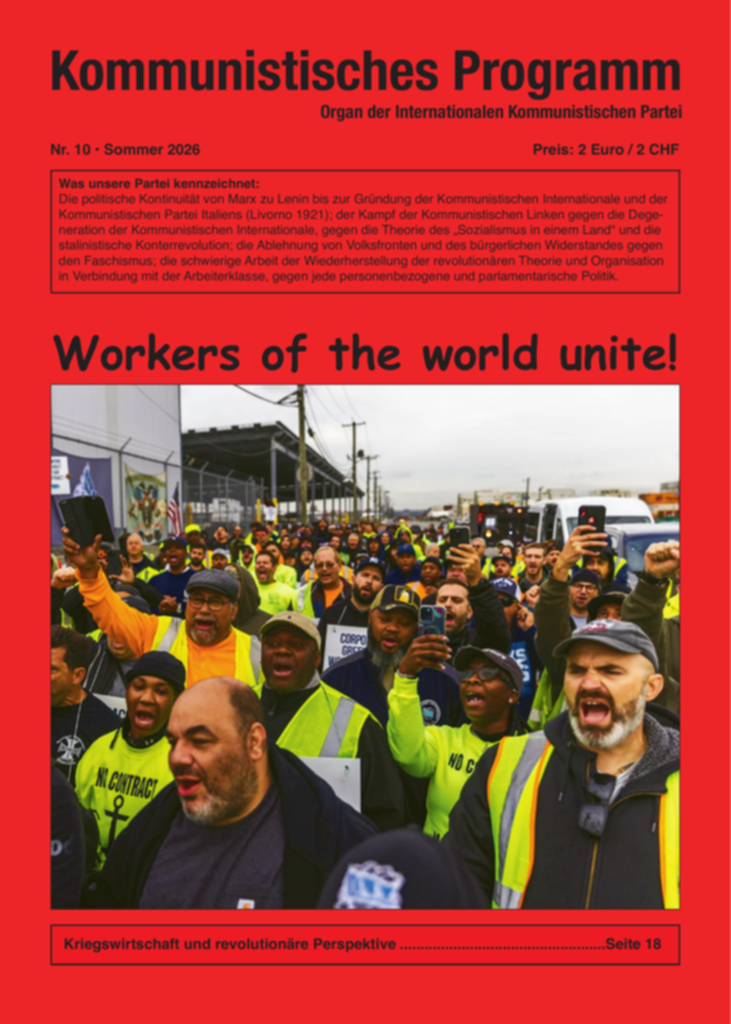
Only a few months ago, when commenting the outcome of America’s presidential elections, we concluded that for some time now in the United States there has been “an often dramatic social situation affecting almost all sectors of the workforce across every region of this vast country. Struggles have multiplied over the years, sometimes conducted by official trade unions with a shameful history behind them and facing strong pressure from workers; and sometimes as an expression of grassroots organizations, which are something of a novelty in the complicated post-World War II era. It’s very simple: workers in the land that symbolizes imperialist domination are in dire straits and can’t take it any more”. And we recalled the series of struggles and unrest that had broken out in diverse sectors in the world of work, from the dockers to the Boeing workers, from workers in the food industry to the coal miners of Alabama, from the joiners, to the installers, to the maintenance staff of telephone companies, from the Amazon workforce to that of the service sector and the so-called gig economy and so on (see: “A Few Words about the US Elections“, the internationalist, no. 11/2025).
Right on the dot, in an attempt to conceal and distort the profound social crisis, populist and reactionary demagogy (the secret card of bourgeois power in all its disguises) appeared on the scene, pointing to the “immigrants” as the cause of all ills and wielding the axe over their heads. And so followed the events we are only too familiar with: arrests and the mass deportation of so- called “illegal aliens” by state power and, in reply, demonstrations that have spread from Los Angeles, at the heart of an area that has always experienced considerable Latin-American and Asian immigation, to other places in the west, gradually affecting cities like Detroit, Chicago, New York. At this point comes the immediate (we might say Pavlovian!) response by the State, deploying massive contingents of the National Guard and the Marines.
We won’t list the news of all the events that have taken place, because the media are full of it, often in the usual sensationalist terms. Just a reminder that this is merely the umpteenth chapter in the long story of the social uprisings that have always marked the situation in the United States ever since the Civil War, which completed the formation of the national market and immersed the country once and for all in the hellish round of capitalism and lastly of imperialism: the fierce workers’ struggles at the turn of the nineneenth/twentieth century with repeated episodes of near civil war, the recurring flare-ups in the Afro-American ghettos crushed by the dual weight of emargination and racism, the widespread proletarian unrest of the 1930s, the huge mobilisations (by the young and not so young) of the 1960s, right up to the more recent rebellions against continuing police violence.
In the burning magma of these rebellions, whether large or small, present or future, repressed with blind brutality or dying out gradually because of the collaboration of the usual ultra-democratic and institutional parties, a dramatic and urgent necessity always emerges, not only to overcome all ethnic, national, religious, cultural or linguistic barriers and side with an authentic class front, getting organised inside and outside the workplace to defend living conditions, but above all for the rebirth of an organ of political direction capable of gathering, unifying and directing the energy generated towards the one and only possible objective (the theoretical and practical struggle for communism), if we wish to avoid relapsing into a pale, bloodless and harmless democratic reformism, the inevitable accomplice to further slaughter, repression, destruction and daily suffering. To sum up, the need for a revolutionary party.