Once again, now that the Great American Electoral Circus has finally upped sticks and left town (democracy at its finest, complete with colourful balloons and strobe lights, a howling public and candidates constrained to perform impossiblly acrobatic back-somersaults in rhetoric to say something meaningful), we can spend a few words on an ignoble farce that has become increasingly vulgar, grotesque and void of content.
Puppets on a String!
Every four years American citizens are asked to pop down to their local polling booths and ‘choose’ between ‘two candidates’, while the world looks on with bated breath. But who are these eternal ‘two candidates’? If you ask us communists where our preferences lie, we always say that the ‘two candidates’ are, quite simply, puppets: ‘The individual subject, especially in societies whose structure is individualistic in nature, is immersed in utmost [...] impotence when looking ahead and showing the way. In such societies – and especially in those dominated by broken-winded liberalism– the higher up the hierarchical ladder the individual gets, the more puppet-like they become, pulled this way and that by deterministic strings.’ That’s what we wrote as early as 1958[1]. With millions, nay billions, of dollars (or other forms of cash) on the table, the indecorous spectacularisation of elections in America and elsewhere has continued to flourish ever since, notwithstanding their sheer emptiness and total absence of real meaning. To obstinately believe that the eternal ‘two candidates’ are anything more than ‘puppets on deterministic strings’ is, therefore, nothing less than blind naivety – heady and celebratory, or masochistic and self-flagellating, depending on the election results. In actual fact they are, to a lesser or greater degree, well-oiled and convincing expressions of much bigger and entrenched economic, financial and social interests that remain hidden in the background precisely because of this kind of personalisation. It is the interests of capital that pull the strings of the puppets on this desolate electoral stage. Contradictory interests, let it be said, just as the entire substance of capitalism – propped up by laws governing the compulsive quest for profit and, consequently, the competitive free-for-all – is contradictory. The ‘narratives’ expounded by these puppets, and the roles they interpret (be they aggressive or inane), are the script destined to fill the minds of those who, out of hope or confusion, believe (or rather, are forced to believe) in it all. Leaving aside all the broken-winded rhetoric which, apart from anything else, is repeated almost word for word at every new round of elections, emptying itself of any real meaning (‘The Golden Age’ or ‘The Light of America’s Promise’ ... yuck), the eternal ‘two candidates’ say practically the same things. They say what the de-personalised power of capital requires them to say and, above all, they do so in a way that is believable. So forget all the idle proclamations fired in the direction of a panegyrical public: Trump, Harris, auntie Mabel, uncle Tom Cobley and all, will do whatever capital requires them to do, reciting the dog-earred script as best they can. If the many ‘experts’ in geopolitics don’t mind...
The single party of capital
We have used inverted commas to refer to the eternal ‘two candidates’ because on closer examination it will be seen that they are nothing more than members of a single party whose binary diversity is only a question of appearance: in its compulsive need to maintain the power of capital over society, the party is united. ‘Liberalism/statism’, ‘globalisation/isolationism’, ‘free trade/protectionism’, ‘increase production/widen demand’, ‘encourage/clamp down on immigration’, ‘fight inflation/fear deflation’, ‘individual freedom/overwhelming state power’, ‘outsourcing/re-industrialisation’, ‘Silicon Valley/Wall Street’, ‘polarisation of wealth/proletarianisation of the half classes’, ‘social expenditure/military expenditure’ and ‘war/peace’ are just some of the huge contradictions (with all the related social repercussions) that capital is unable to solve. And every time, they are ritualistically sold to a public that is paralysed for months on standby.
For the entire period leading up to the Big Show no-one has ever dared to ask the question: “Why are there only two real candidates?” A democracy shouldn’t count on a wide range of positions and, therefore, candidates? [2] Not to be. Undisturbed, the two parties blithely call the shots in a political world awash in a sea of dollars.[3] Millions and millions of dollars. Here, too, can we not see evidence of the single party? The party of capital, the party of democracy of capital for capital? To mis-quote a famous line from the western films of yesteryear: “Capital talk with forked tongue!”
So ...
Democracy? Fascism?
So, the election campaign was largely dominated by the question: “Democracy or fascism?” Or rather (personalisation being the order of the day...): “Is Trump a fascist?” And the prize for the best joke goes to ... John Kelly: retired US Marine Corps general, military medals galore, ex-Secretary of Homeland Security and ex-White House Chief of Staff in the previous Trump administration.[4] When asked if Trump was a fascist, Kelly candidly admitted to having checked the Internet to understand ... what was meant by ‘fascist’, and concluding that yes, Trump’s authoritarian character meant he was a fascist ... Now, joking aside (Kelly’s remarks speak volumes about the substance of ‘political discourse’ in the USA!), what we have here is a recurring mantra in American (but not only) politics: what is democracy and what is fascism?
Of course, everything is personalised in the political-cultural débacle that marks the entire post-Second World War period: the “authoritarian character” of aunt Mabel or uncle Tom Cobley, or little else. As if we needed reminding, fascism is slightly more complex than authoritarianism, lust for power, cruelty, arrogance and militarism as embodied in one or more individuals. On the contrary, as the facts have in reality increasingly borne out, fascism is the economic, financial, political and military substance of bourgeois domination in the imperialist phase (see Lenin again: Imperialism, the Highest Stage of Capitalism), oriented towards the re-organisation of a crisis-ridden post-First World War capitalist economy that is closely threatened by a determined and combative proletarian movement politically oriented towards revolution under the guidance of Communist International through its ‘national’ sections. After World War II that substance would translate into democratic form when, helped along by the dissolution of the Third International under Stalinism, the ‘red threat’ was yet to appear on the horizon and it wasn’t always necessary to use batons to shepherd the lost sheep back into the fold (except in a number of situations!): to do that … Parliament would fit the bill. It was and still is a substance consisting of state interventionism on the economic front, the gradual integration of trade unions into state structures, a strong executive increasingly bent on decree-based legislation, an emptying out of the real functions of a Parliament drowning in a vortex of empty words, social reformism and, whenever the occasion arose, legal and police repression of proletarian revolts (in the little Italy of this time, the application of the infamous Rocco Code in a democratic guise), progressive increases in military spending, more control measures, and so on (and of course that’s without mentioning the oft-repeated resorting to state-sponsored terrorism) … But that’s enough for now – we’ve been over these things several times in the past!
Instead let’s take a moment to look at the USA over the last seventy years: military actions all over the world, U.S. military bases here, there and everywhere, coups wherever needed, undisguised racism in forms and practices resembling a police state, prisons spilling over with proletarians, lumpen proletarians and assorted unfortunates, murderous repression of movements like the Black Panthers and Co., infiltrations and provocations, increasingly sophisticated means of control over society and individuals, hikes in military spending and arms sales worldwide, an ever greater bond between finance and politics, politics and militarism, state interventionism in the economy… We could go on.[5] But we think it’s enough to answer the anxiety-laced question posed by those ‘sincere democrats’ who – while milling it over in their minds – fail to see (do not want to see and cannot see) the reality before their very eyes, and who always end up being taken in – ruinously – by the ‘lesser evil’. Much to their undoing.
Is it really so hard to understand that behind the ‘Make America Great Again’ slogan (with all its menacing undertones) there isn’t only the vulgar arrogance of the man who coined it, but also the vacuous vapidity of his ‘antagonist’? And that everything else (including the empty promises made to the middle classes and working-class aristocracy, or all the nice speeches about ‘civil rights’) is dependent on that? Somebody recently coined the neologism ‘democrature’: we have always spoken of democratic dictatorship or armoured democracy.
Disenchantment or abstention?
All the voting data has yet to be fully examined, but as far as we’re concerned, it matters little if the numbers of people trotting along to the polling stations went up (as it seems, albeit only slightly) or down. Neither are we interested in all the various analyses of the ebbings and flowings to work out the “who voted for whoms?”: all the Women, Men, Youths, OAPs, Immigrants, Labourers, the Country Bumpkins and the City Dwellers and, please, onwards and upwards with the abstract sociological categories: heaven forbid there should ever be a class analysis! Whatever, for us the turnout is not the point because our abstensionism is of a completely different nature and substance. As we wrote in the last edition of our Italian journal:
‘The more the franchise has expanded, the greater its loss of political meaning; the more the franchise has expanded, the more political capacity has been alienated; the more the franchise has expanded, the less its meaning and value. And in almost all the most important States, the number of voters has dwindled progressively. It would seem the influencers and chaste purveyors of the dominant ideology are pulling their hair out as they speak of a ‘worrying abstention.’ But were they blessed with greater intellectual honesty (a rare and poorly rewarded commodity!), they would speak of a disenchantment with voting, i.e., a resigned acceptance of a political personnel that is totally interchangeable. Even the recurring “Ah! They’re all the same”, which goes hand in hand with the “They all stink no matter what!” – statements that resurface to the tune of every petty scandal of this or that clique – express a tacit and resigned acceptance.’
And there’s more:
‘Abstention would imply dissent, albeit passive: instead, this disenchanted acceptance closely resembles a tacit acceptance, a kind of resigned acceptance, which is just waiting in the wings for a good reason to start acclaiming something or someone anew. No revolution-minded individual minimally in touch with reality could attribute even a potentially subversive value to this phenomenon, especially when pedantic amateur sociologists seek to work out, statistically, whether more or fewer residents from ‘working-class districts’ have voted. What is more, hi-tech improvements and the mass media market have succeeded in assembling a machine of consent that has replaced and rendered unnecessary – superfluous to requirements – the organizational structure of political parties representing the masses. And it is by no means a coincidence that behind the idea of the mass party (preferably of ‘workers’), lies a pernicious and persistent nostalgia typical of the multitudes of PCI orphans as well as the theorists and practitioners of the so-called ... ‘conflictual democracy’! Nowadays, the ‘rank-and-file’ of any modern electoral caravanserai no longer consists of poor militants deluded into thinking they are part of a political project, but a coterie of supporters backing teams of politicoes scrambling to winning the Presidency Cup and the Ministry Championship.’
And so:
‘Once again, events as they have unfolded prove us right, regrettably. Abstention cannot be a principle but must be a tactical attitude within a political perspective that ‘reveals class to itself’, part of an all-encompassing and complex anti-institutional political activity that is extra-parliamentary because it is anti-parliamentary; not simply a necessary denunciation of personalistic and electoralist politicking, but an anonymous and hierarchically structured collective preparation against the State and each of its organs and organizations. Abandonment of the ballot box will only take on a politically active meaning when it is recognized as an expression of the radical and revolutionary struggle against Capital, the Bourgeoisie, the imperialist State (all States) and, above all, for the foundation of those organs with which our class, constituting itself as a Party, will exercise its dominance.’[6]
Harsh realities
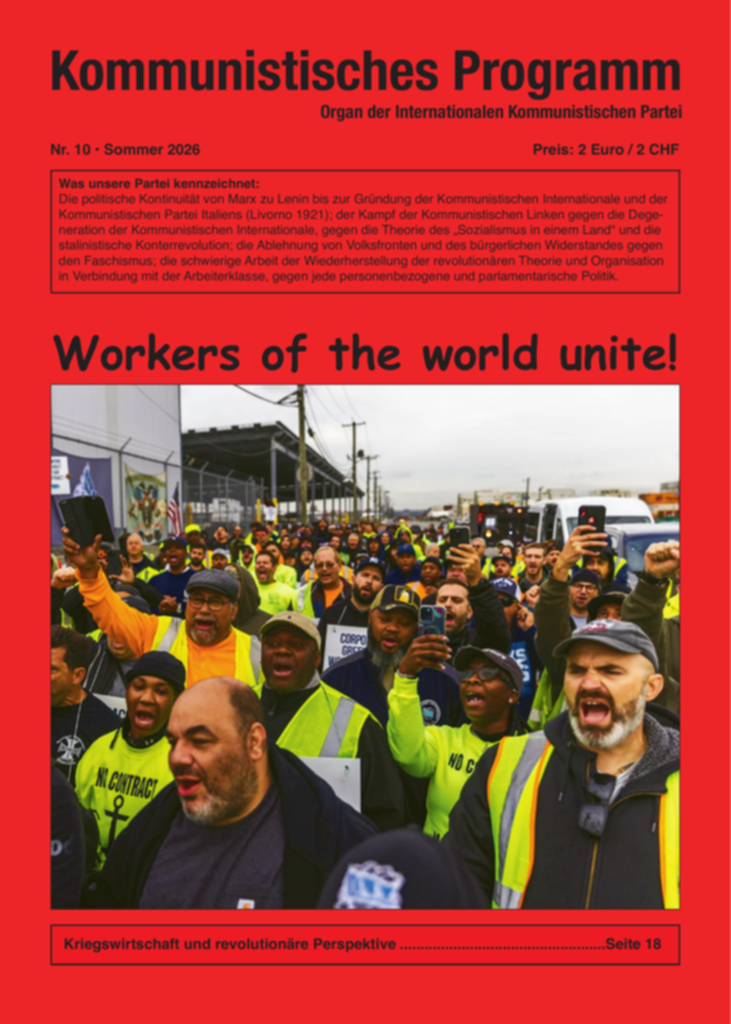
Two days prior to the elections, 45,000 dockworkers on the east coast of the United States, and members of the International Longshoremen’s Association union, ended the three day strike that had completely shut down 36 ports managed by the US Maritime Alliance, from Maine to the Gulf of Mexico (including 14 major ports like Boston, New York, Philadelphia, Baltimore, Miami and Houston). They took home a 62% wage increase over six years, but it still needs to be ratified in January 2025, when the contract that expired last September comes up for renewal (no surprises then if either side decides to let off a few fireworks…).
The action of the dockworkers carries symbolic significance because these workers have always been a highly combative category which, over the decades, has had to fight both against employers and criminal infiltrations into the union; and also because it can be seen as the tip of an iceberg: conflict has become more widespread throughout the country, primarily as a result of increasingly difficult working conditions, with wages eroded by rising inflation.
Indeed, the dockworkers were not the only ones to down tools. For over seven weeks, they were joined by 33,000 Boeing workers who, on 4th November, approved (with 59% of the members of the International Association of Machinists-District 751) a 38% wage increase and measures to update a pension plan that the company had long refused to implement.
But alongside these headlining strikes, there has been a multitude of others, which we can only partially list here: at John Deere (agricultural machinery), GM, Ford, and Stellantis (automobiles); in the coal mines of Alabama; at Nabisco and Kellogg’s (food industry); among nurses and, more generally, healthcare workers in California and New York State and at the Kaiser Permanente healthcare company; among carpenters in Washington and Hollywood film and TV workers; in the services sector and in the so-called gig economy where temping is the name of the game and ultra low wages the order of the day; at Amazon and foods company Frito-Lay; AT&T and Google (telecommunications), among workers in telephone installation and maintenance, and the list goes on … Here too, salary hikes, pensions and better living and working conditions have topped the agenda; but there have also been plenty of examples of solidarity strikes with workers in different categories, and that is interesting.[7] What does all this tell us?
Well, it tells us that behind all the glitter, dancers and puppets of the Great Electoral Circus, there exists an often dramatic social situation affecting almost all sectors of the workforce across every region of this vast country. Struggles have multiplied over the years, sometimes conducted by official trade unions with a shameful history behind them and facing strong pressure from workers; and sometimes as an expression of grassroots organizations, which are something of a novelty in the complicated post-World War II era. It’s very simple: workers in the land that symbolizes imperialist domination are in dire straits and can’t take it any more. Of course, we aren’t looking to overstate the importance of these episodes, but it would be just as criminal to downplay them with a shrug of the shoulders. The American working class is a heterogeneous body, and there can be no doubt that the road towards a deeper and more widespread awareness of the need for open and constant antagonism is still long and winding; and neither can anyone doubt especially that a powerful and well-rooted international revolutionary party needs to make its presence felt along the way.
With regard to the first point, it will once again be a case of material factors and determinations doing their work; with regard to the second, we will continue to do ours.
November 2024
[1] From ‘La teoria della funzione primaria del partito politico, sola custodia e salvezza della energia storica del proletariato: Contenuto originale del programma comunista è l’annullamento della persona singola come soggetto economico, titolare di diritti e attore della storia umana [Theory of the primary function of the political party, sole custodian and saviour of the proletariat’s historical energy: Original content of the communist program is the nullification of the single individual as an economic subject, owner of rights and actor in human history],’ Il programma comunista, nos. 21 and 22/1958.
[2] We’re well aware that in the latest greatest circus show there was a third candidate, Jill Stein, whose leanings were ‘green’, but she was spurned by the electorate. As for the much vaunted ‘left’ of the Democratic Party, i.e., that represented by Bernie Sanders and Alexandria Ocasio-Cortez, the left is all one with the party, and we will address this another time.
[3] In 2010 ‘the winners in elections for the House spent $1.4 million on average during their campaign. And what about the Senate? Almost seven times as much.’ And, in 2014, ‘for the first time ever, the majority of Congress members [is made up of] millionaires.’ And then there’s this: ‘the wealth of Nancy Pelosi, President of the Democrats in the House, rose from $41 million in 2004 to $115 million in 2018 while [...] that of Mitch Connell, leader of the Republican majority in the Senate, went from $3 million to over $34 million during the same period’ (see Bruno Cartosio, Gli Stati Uniti oggi. Democrazia fragile, lavoro instabile, Roma 2024, p.97). Some tasty nuts to get your teeth into between one circus act and another ...
[4] Turncoating is an interesting aspect of the last elections: the ease with which certain party bigwigs left one party for another confirms the nature of the single party ...
[5] With this in mind, we’ll go back in time to what we already reported in another article in this issue (The Resistible Rise of the Ignoble ‘Free World’) – the words of W. J. Astore, an ex-officer in the U.S. Army: “No other nation in the world sees its military as (to borrow from a short-lived Navy slogan) “a global force for good.” No other nation divides the whole world into military commands like AFRICOM for Africa and CENTCOM for the Middle East and parts of Central and South Asia, headed up by four-star generals and admirals. No other nation has a network of 750 foreign bases scattered across the globe. No other nation strives for full-spectrum dominance through “all-domain operations,” meaning not only the control of traditional “domains” of combat — the land, sea, and air — but also of space and cyberspace. While other countries are focused mainly on national defense (or regional aggressions of one sort or another), the U.S. military strives for total global and spatial dominance. Truly exceptional!” Forget the glitz and gloss of Philadelphia and New York, or the dullness of Main Street America: there’s no mincing of words here!
[6] “Il dominio della borghesia tra costruzione del consenso ed esercizio della coercizione (Qualche considerazione a proposito di disaffezione e partecipazione elettorale)”, il programma comunista, no.4/2024. Available on our site www.internationalcommunistparty.org.
[7] 7 Cf. B. Cartosio, cit., and also his “Stati Uniti: soggetti e strategie di lotta nel mondo del lavoro”, in Officina Primo Maggio, https://www.officinaprimomaggio.eu/ 2/11/2024.